The Eloquence of Restraint: Understanding Why True Luxury No Longer Announces Itself
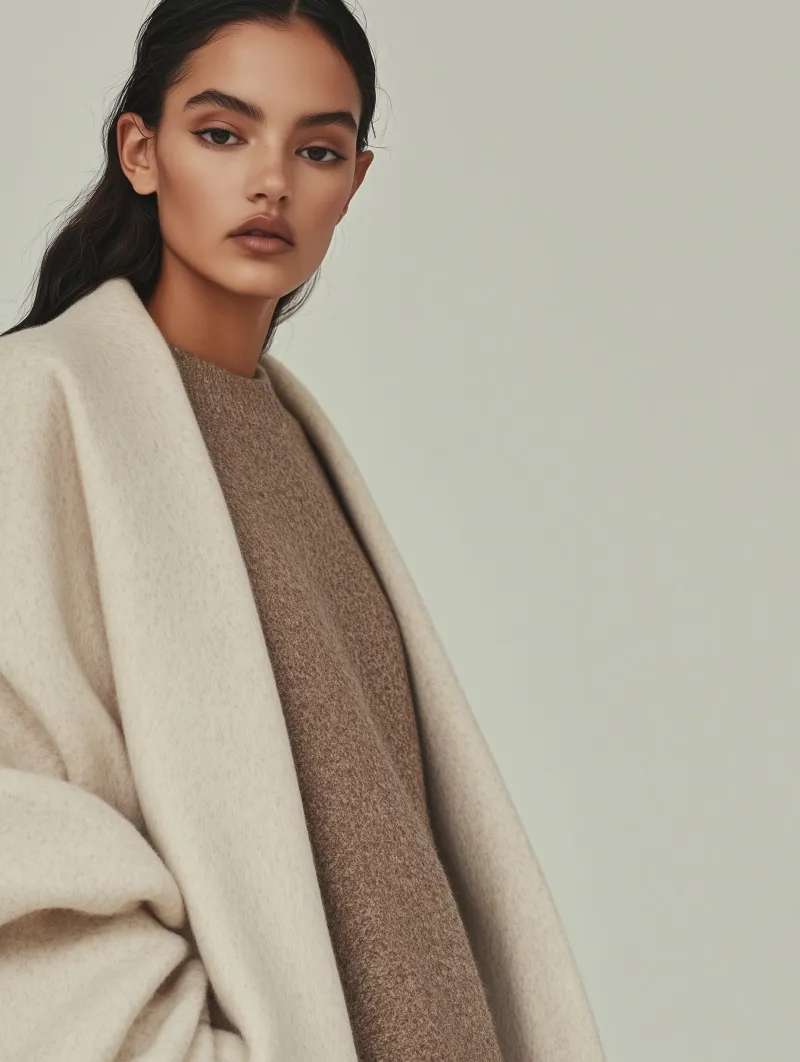
Photo: understated luxury fashion minimal elegant woman neutral tones quality fabric, via assets.lummi.ai
For much of the past two decades, the language of luxury was loud. Logos stretched across the chest. Interlocking monograms on every surface. Status communicated not through subtlety but through volume — a fashion vocabulary that required no fluency to read, because it was designed to be legible at a distance.
Something has shifted.
Look closely at the women who occupy the quieter corners of American cultural influence — the art collectors, the architects, the editors who have been in the industry long enough to have outgrown the need to prove anything. They are not dressed in last season's most-photographed pieces. They are wearing a perfectly weighted cashmere coat in an unremarkable shade of oat. A silk blouse with a collar that falls just so. Trousers with a crease so precise it seems structural. Nothing announces itself. Everything communicates.
This is quiet luxury — and it is not a trend. It is, if anything, a correction.
The Psychology Behind the Shift
To understand why understated elegance has reclaimed its position as the ultimate status signal, it helps to understand what conspicuous consumption was always communicating in the first place.
Thorstein Veblen, the economist who coined the term in 1899, observed that visible spending served a social function: it communicated wealth and, by extension, social standing. For much of the twentieth century, luxury fashion operated precisely within this framework. A recognizable logo was a shorthand — efficient, universal, and deliberately accessible to the gaze of strangers.
But legibility, it turns out, has a ceiling. When a logo becomes too widely recognizable, when it appears on both the $4,000 handbag and the $400 imitation, its signal degrades. The most sophisticated consumers — those for whom the original signal was created — quietly move on. They seek a new vocabulary, one that cannot be replicated at scale. And that vocabulary, almost invariably, is quality.
What cannot be easily copied is not a pattern or a monogram. It is the hand of a fabric. The weight of a well-constructed seam. The way a garment holds its shape after years of wear. These are the signals that require fluency to read — and that is precisely their appeal.
Recognizing Quality When You See It
For women new to this mode of dressing, the shift can feel disorienting. Without a logo as a guide, how does one identify genuine quality? The answer lies in developing a more tactile, educated relationship with clothing — one that prioritizes material intelligence over brand recognition.
Fabric first, always. The most immediate indicator of quality is how a fabric feels and moves. Natural fibers — wool, silk, cashmere, linen, fine cotton — have a weight and drape that synthetic alternatives struggle to replicate convincingly. Run a silk blouse through your fingers: quality silk has a cool, fluid hand and a subtle luminosity. A cheap imitation feels slippery and insubstantial. These distinctions are learnable, and they become instinctive with practice.
Construction over decoration. Examine the seams of a garment — are they finished cleanly, with enough seam allowance to allow for alterations? Are the buttons sewn on with reinforced stitching? Does the lining move with the outer fabric rather than against it? On a quality garment, the interior is nearly as considered as the exterior. On a lesser one, the inside reveals what the outside conceals.
Proportion and fit. Truly well-made clothing is designed with proportion in mind. Sleeves fall at the correct point on the wrist. A shoulder seam sits precisely where it should. Pockets, when present, lie flat rather than pulling. These are not accidents — they are the result of pattern-making expertise and considered construction. They are also, notably, invisible to anyone who is not looking carefully.
The American Context
In the United States, quiet luxury carries a particular cultural nuance. American fashion has long oscillated between two poles: the democratic ideal that style should be accessible to all, and the aspirational pull of visible wealth. Quiet luxury, in the American context, represents a third way.
It draws from the long tradition of East Coast prep — the worn-in loafers, the understated navy blazer, the inherited quality of old money — but strips away the insularity and exclusivity that tradition sometimes carried. It borrows from West Coast minimalism, too: the commitment to clean lines, natural materials, and function as its own form of beauty.
What emerges is a distinctly modern American elegance: confident without being performative, refined without being precious. It is the aesthetic of a woman who has done the work — on herself, on her taste, on her understanding of what actually endures — and no longer requires external validation.
Rejecting the Cycle Without Rejecting Style
It would be a mistake to conflate quiet luxury with a rejection of fashion itself. The women who embody this aesthetic are not indifferent to clothing — they are deeply engaged with it. The difference is that their engagement is selective, considered, and immune to the urgency of the trend cycle.
They buy less, and they buy better. They develop relationships with specific brands — often smaller, craft-driven labels — whose values align with their own. They invest in alterations, in proper care, in the small rituals that extend the life of a well-made garment. This is not asceticism. It is connoisseurship.
And in a culture that has grown exhausted by the relentless churn of micro-trends and algorithm-driven "must-haves," this approach feels increasingly like relief.
The Signal That Requires No Volume
There is an old maxim, attributed to various sources over the years, that true elegance is refusal. The willingness to say no — to the unnecessary, the superfluous, the merely attention-seeking — is itself a form of sophistication.
Quiet luxury is, at its core, an exercise in that refusal. It refuses the easy legibility of the logo. It refuses the validation of the trend cycle. It refuses the idea that style must be loud to be seen.
And in doing so, it communicates something that no amount of branding can manufacture: a settled, unhurried confidence in one's own taste. In a room full of noise, that silence is the most powerful statement of all.
At Sheer Inspirations, we have always believed that true style is not worn for the room — it is worn for oneself. Quiet luxury is not a new idea. It is the oldest one, finally having its moment again.
