Dressed With Intention: How a Simpler Wardrobe Quietly Builds Unshakeable Confidence
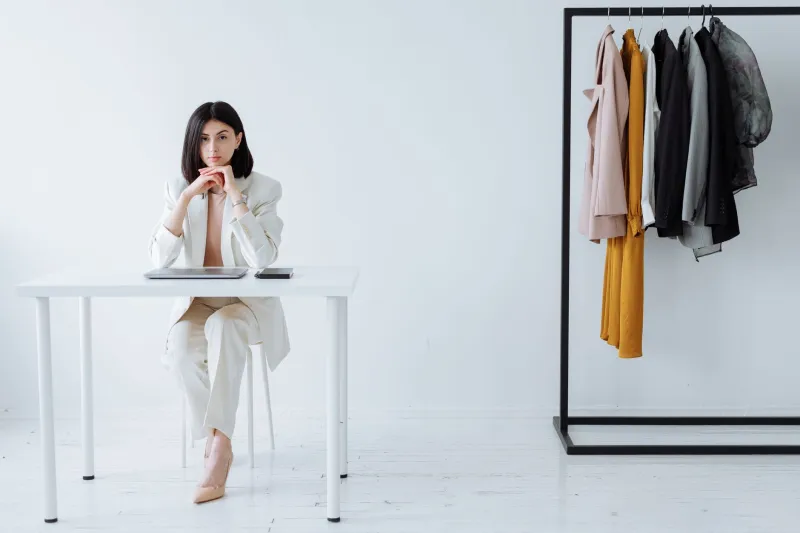
There is a particular kind of confidence that does not announce itself — it simply exists, steady and unhurried, in the woman who has learned to dress with deliberate restraint. The connection between a curated wardrobe and genuine self-assurance runs deeper than aesthetics. It reaches into the quieter corners of psychology, daily ritual, and the way a woman chooses to meet the world each morning.
For many women, the wardrobe represents something far more complex than clothing. It is a daily negotiation — with identity, with expectation, with the relentless noise of a culture that insists more is always better. And yet, a growing number of thoughtful dressers are arriving at the same quiet conclusion: that fewer, better pieces do not diminish a woman's presence. They amplify it.
The Exhausting Mathematics of Too Many Choices
In 2000, psychologists Sheena Iyengar and Mark Lepper published research that would eventually reshape how we think about consumer behavior and personal satisfaction. Their findings were counterintuitive and, for many, deeply liberating: an abundance of options does not increase happiness. It undermines it. The phenomenon, now widely known as decision fatigue, is nowhere more quietly destructive than in the morning ritual of getting dressed.
When a closet holds forty-seven items that technically fit but only twelve that feel genuinely right, the cognitive cost of navigating that space each day is real and cumulative. It is not vanity to acknowledge this — it is self-awareness. Every unnecessary decision made before 9 a.m. is energy borrowed from the clarity and presence you bring to everything that follows.
The woman who opens a wardrobe of considered, well-chosen pieces does not face that same tax. Her mornings move differently. There is a fluency to her choices, a lack of friction that frees her attention for the things that actually matter. This is not a small gift. Over the course of a week, a month, a year, it becomes a profound one.
What Quality Actually Does to the Body
There is something that happens when a woman puts on a garment that was made well — cut with precision, constructed from fabric that drapes and moves with intention. It is not imagined. The physical experience of wearing something that fits correctly, that holds its shape through the day, that does not require constant adjustment or self-consciousness, changes posture. It changes gait. It changes the quiet, continuous background noise of how a woman feels inhabiting her own body.
This is the dimension of quality that rarely appears in conversations about investment dressing. The discussion typically centers on cost-per-wear, on longevity, on environmental responsibility — all valid considerations. But the more intimate case for quality is this: a well-made garment removes you from the equation. You stop thinking about what you are wearing, and you begin simply being the person wearing it.
That shift — from self-consciousness to self-possession — is where genuine confidence lives.
The Identity Clarity That Comes From Editing
A wardrobe that has been genuinely curated is, in its way, a statement of self-knowledge. It reflects not who you aspire to be on some theoretical future occasion, but who you actually are today — the life you are living, the values you hold, the aesthetic that resonates most deeply with your own sense of beauty and order.
The process of reaching that clarity is rarely comfortable. It asks you to release the aspirational pieces purchased for a version of yourself that never quite materialized, the impulse buys that seemed compelling in the store and confusing at home, the items kept out of guilt or inertia rather than genuine affection. That process of honest subtraction is, in itself, an act of confidence — a declaration that you know yourself well enough to choose deliberately.
Women who have done this work consistently describe a particular sensation on the other side of it: not loss, but relief. A wardrobe that reflects you accurately is one you can trust. And trusting your wardrobe means trusting yourself, which is perhaps the most foundational form of self-assurance there is.
The Presence That Restraint Creates
In a cultural moment saturated with maximalism — with the loud, the layered, the algorithmically optimized for attention — restraint has become genuinely radical. The woman who enters a room simply, wearing something beautiful and precisely right for her, is remarkable precisely because she is not competing for notice. She has already settled the question of who she is. That settledness reads as presence.
This is not about minimalism as an aesthetic doctrine, nor is it an argument for austerity. It is an observation about what happens when a woman's exterior and interior are in alignment — when what she wears is a genuine extension of how she thinks and who she has chosen to become. That coherence is magnetic in a way that volume and variety rarely are.
Psychologists who study impression formation note that consistency — in behavior, in appearance, in manner — is one of the primary signals through which others perceive confidence and competence. The woman who presents herself with the same considered clarity on a Tuesday morning as she does at a Saturday evening dinner is communicating something important: she is not performing. She simply is.
Beginning the Shift
For women accustomed to a full and varied wardrobe, the prospect of paring down can feel like risk. The fear, usually unspoken, is that fewer options will somehow leave you exposed — without the right thing for the right moment, without the range to adapt and respond.
The reality, for those who have made the transition, tends to be the opposite. A smaller wardrobe of pieces you genuinely love and that genuinely work creates a kind of wardrobe fluency — the ability to dress quickly and well without effort, to trust that what you reach for will serve you. That fluency is its own form of freedom.
The starting point is not a dramatic purge but a more honest audit: not do I own this? but does this belong to me? Does it fit the life I am actually living? Does it reflect the woman I am working to become? Does wearing it make me feel more like myself, or less?
The pieces that answer yes to those questions deserve to stay. The ones that cannot are quietly holding you back — not because they are wrong, but because they are not right enough.
The Quiet Power of Knowing
Confidence, at its most essential, is simply knowing. Knowing who you are, knowing what you value, knowing that you have made considered choices you can stand behind. A wardrobe built on those same principles — on genuine self-knowledge, on the quality that endures, on the restraint that signals certainty rather than limitation — is not a small thing.
It is, in the most practical and elegant sense, a daily practice in becoming the woman you intend to be.