The Brand Nobody Knows: Why Anonymous Luxury Has Become the Loudest Statement in the Room
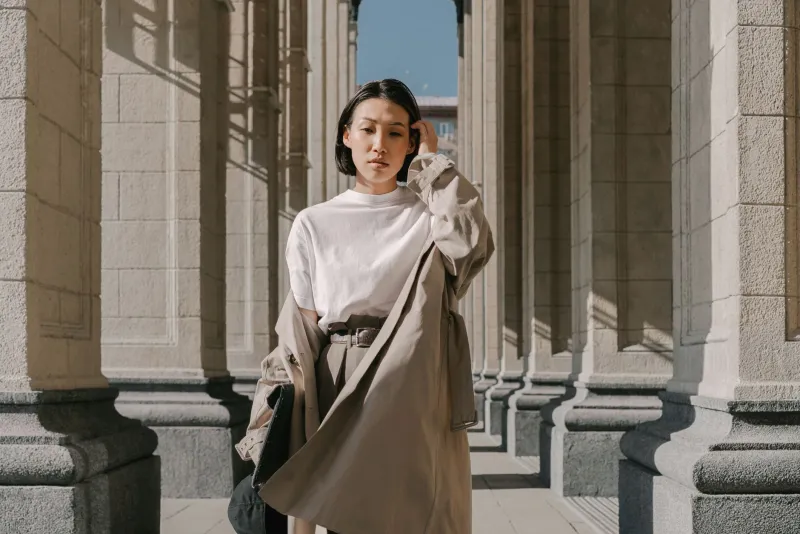
There is a particular kind of confidence that requires no announcement. It does not arrive with a recognizable monogram stitched across the chest or a hardware-laden bag swinging from the crook of an arm. It arrives quietly, in the cut of a coat that falls precisely so, in fabric that behaves unlike anything found on a department store rack, in a silhouette so considered it needs no label to justify itself. This is the new language of American luxury—and it is spoken in a register most people cannot yet hear.
For years, visible branding functioned as shorthand. A logo communicated wealth, aspiration, membership. It told a story in an instant, requiring nothing of the observer except recognition. But something has shifted, and it has shifted decisively among the women who set the tone rather than follow it.
The Fatigue of Being Read at a Glance
There is a particular exhaustion that comes with being immediately legible. When a garment announces its origin before its wearer has said a word, it flattens the encounter. The conversation has already been had. The judgment has already been rendered. For a woman who has spent years developing a considered relationship with her wardrobe, this kind of instant readability begins to feel like a constraint rather than a statement.
The most discerning dressers in cities like New York, Chicago, and Los Angeles have begun to articulate this shift, not always in words, but in choices. The logo-forward bag is replaced by something unbranded, beautifully structured, sourced from a small atelier most people have never encountered. The recognizable trench gives way to one cut from a heritage cloth house whose name exists only in the vocabulary of those who seek it out. The effect is not invisibility. It is, paradoxically, a more commanding presence.
When a garment offers no immediate explanation for itself, it invites a second look. It creates curiosity. And curiosity, in style as in life, is far more compelling than certainty.
Conspicuous Restraint as the New Currency
Economists and cultural critics have long discussed conspicuous consumption—the practice of purchasing and displaying goods as a public demonstration of wealth. What is emerging now might be understood as its precise inversion: conspicuous restraint. The deliberate absence of display. The choice to wear something that rewards knowledge over recognition.
This is not anti-luxury. It is, in many respects, a more demanding form of it. To dress in unlabeled, heritage-crafted pieces requires a depth of research and discernment that no logo can substitute for. It demands that a woman know the difference between a well-constructed seam and a merely adequate one, that she understand why a particular wool house in the American Northeast or a linen weaver operating in a small European village produces cloth that cannot be replicated at scale. The knowledge itself becomes the marker of taste.
There is something genuinely egalitarian in this, even if the price points are not always modest. A woman who has built this kind of wardrobe cannot be immediately read. She cannot be catalogued. She moves through the world on her own terms, legible only to those who share her fluency.
What the Unlabeled Piece Actually Signals
It is worth being precise about what is being communicated when a woman chooses a piece that carries no recognizable name. She is not signaling poverty or indifference. She is signaling something far more specific: that she has moved beyond the need for external validation of her choices. That she has done the work. That her eye is her authority.
In this context, wearing something no one has heard of is not a risk. It is a declaration. It says, quietly and without apology, that the wearer's relationship with her clothing is personal rather than performative. That she dressed for the texture of the fabric against her skin, for the way the hem moved when she walked, for the satisfaction of a garment that fits as though it was made with her particular proportions in mind—because, in many cases, it was.
This is the promise of the small atelier, the heritage mill, the independent maker whose output is limited by design. These are not brands that advertise. They are discovered. And the act of discovery—patient, deliberate, informed—is itself a form of style.
The Shift Happening in American Closets
Across the United States, there is evidence of this recalibration in the conversations women are having about their wardrobes. The resale market, often cited as a barometer of desire, tells part of the story: while certain logo-heavy pieces continue to trade at premium prices, there is growing demand for unlabeled vintage and for contemporary pieces from makers who operate outside the visibility of mainstream fashion media.
Style communities, both online and in person, increasingly celebrate the find that requires explanation—the coat from a brand most members have never encountered, the bag whose provenance requires a paragraph to describe. The explanation itself has become the point. It is an opportunity to share knowledge, to demonstrate that one's taste has been earned rather than purchased wholesale from a single recognizable house.
This does not mean that established luxury brands are irrelevant. It means that their most sophisticated customers are becoming more selective about which pieces they choose and why. A woman who once relied on a logo for the entirety of her style story may now choose one considered piece from a heritage house and build the rest of her wardrobe from sources that exist beneath the surface of mainstream awareness.
Dressing for the Few Who Know
There is an old idea in style—one that predates the logo era by centuries—that true elegance is recognized by relatively few people, and that this is precisely the point. The woman who dressed beautifully in 1920s Paris was not necessarily wearing the most famous name. She was wearing the most considered garment, sourced with patience and worn with conviction.
What is happening now is not a trend. Trends, by definition, are temporary and widely adopted. This is something older and more durable: a return to the understanding that style is a private conversation between a woman and her clothes, and that the most meaningful exchanges happen away from the noise of mass recognition.
To dress in pieces that only some will understand is to trust one's own judgment above the market's approval. It is, in the most precise sense, the definition of personal style—refined not for an audience, but for the self. And in that quiet confidence, there is an authority that no logo has ever been able to manufacture.