The Quiet Inventory: What a Shopping Pause Reveals About Who You Already Are
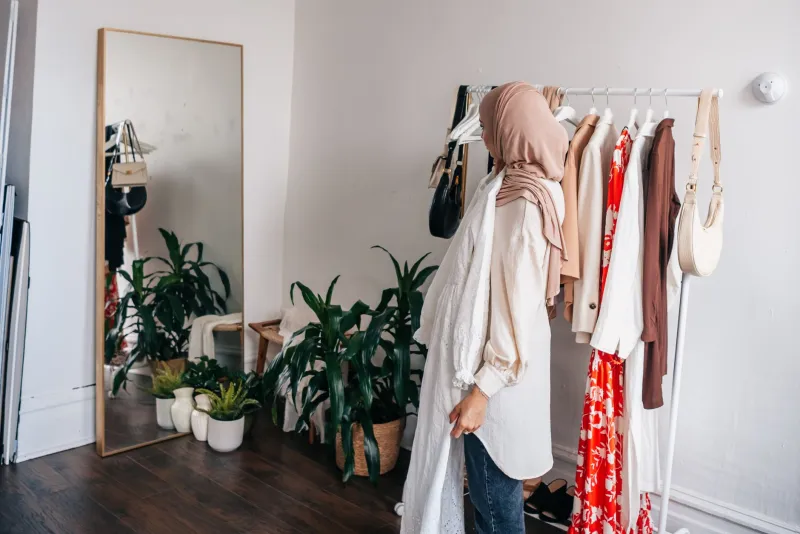
There is a particular kind of noise that accumulates inside a well-stocked closet. It is not the noise of too many garments competing for space — though that, too, is real — but the noise of unexamined wanting. Every unworn blouse, every impulsive weekend purchase still bearing its tag, every piece acquired in the quiet hope that it might transform something about daily life: together, they constitute a kind of static. And like most static, it is nearly impossible to hear anything useful through it.
What happens, then, when you turn it off?
For many women, a deliberate pause in shopping begins as a practical experiment — a financial reset, a New Year's resolution, or simply the dawning recognition that nothing in a full closet feels quite right. But the pause rarely stays practical for long. Something else emerges in the stillness, something more personal and, for many, more surprising than they anticipated.
The First Discovery: What You Actually Reach For
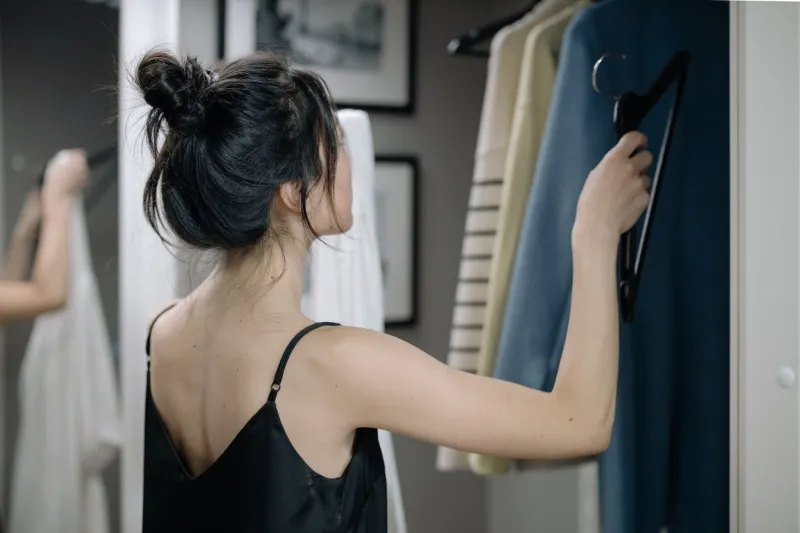
Within the first few weeks of a shopping moratorium, most women report an almost involuntary reckoning. Without the possibility of acquiring something new, the eye is forced inward. You begin to notice, with a precision that daily life rarely affords, exactly which pieces you return to again and again — and which ones you quietly sidestep every single morning.
This is not information the mirror provides. The mirror shows you the result of a choice already made. What the pause reveals is the pattern of choosing itself: the navy trousers you reach for without thinking, the silk blouse that feels like a reward, the structured coat that straightens your posture the moment you button it. These are not accidents. They are a vocabulary, one you have been assembling for years without quite recognizing it as language.
Conversely, the pieces you avoid become equally instructive. The dress purchased for a version of yourself that attends more cocktail parties. The trend-forward jacket that felt right in the fitting room of a Soho boutique and has felt slightly wrong ever since. Freed from the impulse to acquire, the mind turns critical in the most useful way: not toward your body or your taste, but toward the gap between what you own and what you genuinely inhabit.
What Lifestyle Has Been Trying to Tell You
One of the more quietly revelatory aspects of a shopping pause is how clearly it illuminates the distance between your imagined life and your actual one. American consumer culture is extraordinarily skilled at selling aspiration. Catalogs and curated feeds present versions of existence — the effortless weekend, the sunlit dinner party, the Monday morning that looks like an editorial — that bear only a passing resemblance to the texture of real days.
When you stop shopping, you stop feeding that aspirational gap. What remains is your actual life: your commute, your office, your preferred Saturday, your genuine relationship with formality and ease. And your wardrobe, stripped of the new arrivals that briefly paper over the disconnect, begins to speak directly to whether it is serving that life or decorating a fantasy of it.
This is not a small discovery. Women who have undertaken extended shopping pauses — some lasting a season, others stretching to a full year — frequently describe a reorientation of their entire approach to dress. Not a narrowing, but a clarification. The question shifts from What would I like to own? to What does my actual life require of me, and do my clothes support that honestly?
The Identity Underneath the Acquisition
Perhaps the most intimate revelation of the shopping pause is what it discloses about identity. Shopping, for many women, functions as a form of ongoing self-definition — a way of continuously revising and restating who we are or who we intend to become. There is nothing inherently wrong with this. Dress has always been a medium for self-expression and social navigation.
But when acquisition becomes reflexive rather than considered, it can obscure rather than clarify. The woman who shops whenever she feels uncertain about a social situation, or anxious about how she is perceived professionally, or simply restless on a slow afternoon, is using clothing as a response to feeling rather than as an expression of it. The pause interrupts that loop.
In its place, something quieter and more durable tends to emerge: a recognition of preferences that predate any particular trend cycle, any specific job, any relationship or social circle. Women describe returning to colors they have always loved but somehow drifted from, silhouettes that feel instinctively right, and a general aesthetic sensibility that turns out to be more stable and more distinctly their own than years of shopping had suggested.
There is something almost archaeological about the process. Beneath the layers of recent acquisition, a more essential self has been there all along, patiently waiting to be uncovered.
The Wardrobe as a Living Document
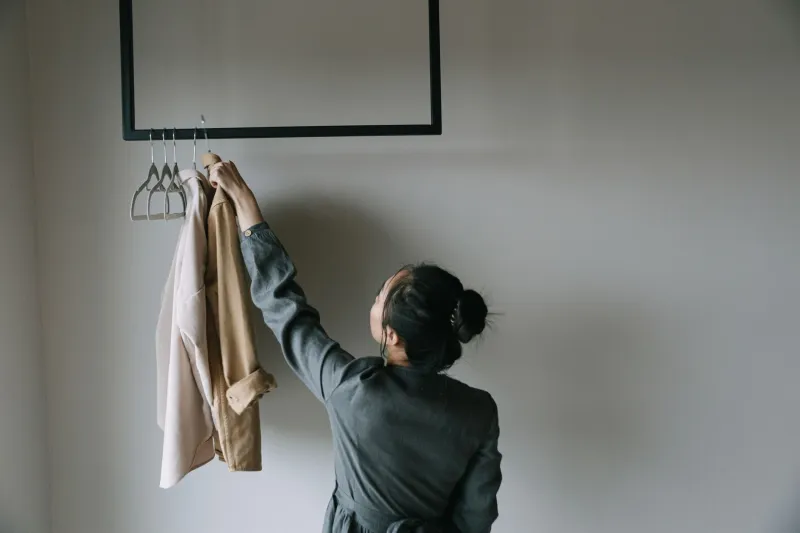
To stop shopping and start noticing is, in the most practical sense, to begin treating your wardrobe as a document rather than a destination. Every piece you own carries information: when you bought it, what you were hoping it would do, how your relationship with it has evolved or failed to evolve. Read together, these pieces tell a story that is specific to you — your sensibilities, your transitions, your recurring blind spots, and your most enduring instincts.
This reading requires no particular expertise. It requires only stillness and a willingness to be honest about what you find. Which garments make you feel entirely yourself? Which ones require a kind of performance you are no longer interested in giving? Where does your closet reflect your life accurately, and where does it reflect a life you have outgrown or never quite inhabited?
The answers, once you begin to hear them, have a way of informing everything that comes after — not just future purchases, but the entire relationship between the woman and her wardrobe. Shopping, when it resumes, tends to be slower, more deliberate, and considerably more precise. Not because the pause has imposed discipline from the outside, but because it has clarified desire from within.
What Silence Makes Possible
Elegance, at its most essential, is not about abundance. It is about the kind of coherence that only becomes possible when the unnecessary has been set aside. The shopping pause is, at its core, an act of subtraction — and like all genuine subtraction, it creates space for something more considered to take shape.
What emerges in that space is not emptiness. It is attention. And attention, turned honestly toward the wardrobe you already possess, may be the most transformative styling tool available to any woman — more revealing than any personal shopper, more clarifying than any trend report, and considerably less expensive than either.
The closet has always been speaking. The pause is simply how you learn to listen.