What Your Fingers Know: The Case for Choosing Fabric Over Fame
There is a particular kind of knowledge that cannot be acquired by scrolling. It lives in the hands—in the practiced ability to lift a sleeve, feel its weight, and understand, within seconds, whether a garment is worth a second look. This is the intelligence of textile literacy, and among women who dress with genuine intention, it has quietly become the most coveted fluency of all.
In an era saturated with visible branding, the truly discerning have turned their attention inward—or rather, closer. Not to the label stitched inside a collar, but to the threads themselves.
The Illusion of the Label
For decades, the fashion industry conditioned consumers to equate a recognizable name with quality. The logic was seductive in its simplicity: a prestigious house must, by extension, produce prestigious goods. And while heritage brands have certainly produced extraordinary textiles, the equation has never been as reliable as marketing would suggest.
The truth is more nuanced, and ultimately more empowering. A label tells you about provenance and marketing investment. It tells you very little about how a garment will feel against your skin at noon on a Tuesday in July, or whether the fabric will hold its structure after a year of careful wear. Those answers come from the cloth itself.
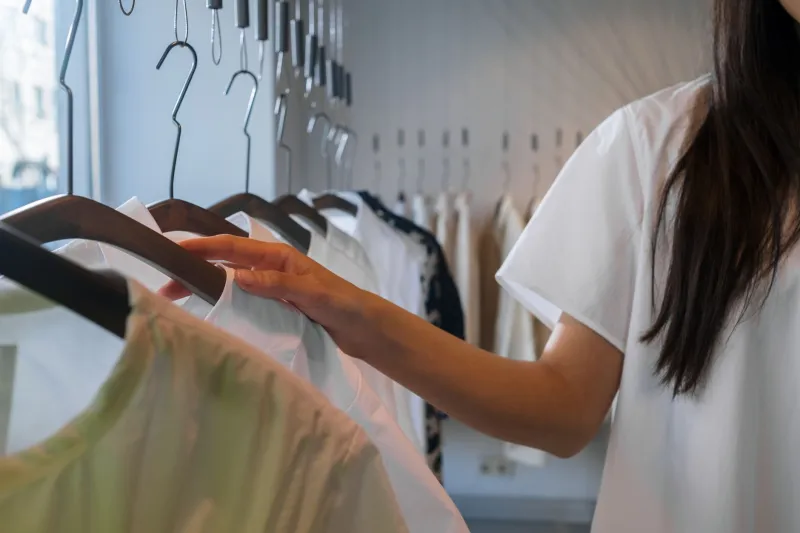
Women who understand this distinction shop differently. They slow down. They handle garments before they examine them. They have learned to let their senses lead.
Reading a Fabric: Where to Begin
Textile literacy does not require a degree in textile science. It begins with a few foundational questions, asked consistently, until the answers become instinctive.
What is the fiber content? Natural fibers—wool, silk, linen, cashmere, cotton—breathe, age, and respond to the body in ways that synthetics rarely replicate. A fine merino wool will soften with wear; a quality silk charmeuse will drape with increasing fluidity over time. Synthetic blends are not without merit—a small percentage of elastane in a tailored trouser can preserve structure beautifully—but understanding what you are working with is the essential first step.
What is the weave construction? The way threads are interlaced determines everything from how a fabric moves to how it resists wear. A tightly woven broadcloth has a different authority than a loosely woven gauze. A herringbone tweed carries weight and intention. A plain-weave linen announces ease. None is superior in the abstract; each is suited to specific purposes, and knowing the difference allows for purposeful selection.
What is the hand? This is the term textile professionals use to describe the tactile quality of a fabric—its softness, drape, resilience, and surface texture. A fabric with excellent hand feels considered. It does not scratch, pill prematurely, or feel insubstantial. It has a quality that is immediately apparent and deeply satisfying.
The Sensory Intelligence of Dressing Well
There is something quietly radical about prioritizing how a garment feels over how it photographs. We live in a visual culture that has trained us to optimize for the image—the flat lay, the mirror selfie, the well-lit outfit post. But clothing is, at its core, a tactile experience. You wear it. It moves with you. It is the first thing you feel when you dress in the morning and the last thing you remove at night.
A woman who has spent years building a wardrobe around fabric quality will tell you that the experience of dressing changes entirely. Reaching for a piece of substantial Italian wool crepe rather than a synthetic approximation is not a small pleasure. It is a daily act of self-respect—a quiet insistence that the things touching your body should be worthy of it.
This is where the philosophy of Sheer Inspirations finds its most literal expression. Refinement is not about surface. It is about what lies beneath—the construction, the composition, the consideration embedded in every thread.
Fabrics That Age Beautifully
One of the most practical arguments for textile literacy is longevity. Quality fabrics do not simply last longer—they evolve in ways that synthetic alternatives cannot. A linen blazer softens and relaxes into something more personal with each season. A cashmere sweater, properly cared for, becomes a quietly irreplaceable object. A well-woven silk blouse holds its luminosity in a way that polyester satin can only approximate for a short time before the illusion fades.
This aging process is not deterioration. It is character. And it is only possible when the underlying fiber has the integrity to develop it.
The economics follow naturally. A garment that improves over three to five years of wear costs less per use than an inexpensive piece that pills, distorts, or loses its shape within a season. Fabric knowledge, in this sense, is also financial intelligence—a point worth making plainly in a culture that often conflates spending more with spending wisely.
Practical Guidance for Developing Your Textile Eye
Becoming fabric-literate is a practice, not a credential. It develops through attention and repetition.
Begin by reading care labels with genuine curiosity rather than obligation. Notice the fiber percentages. Consider what they mean for wear and maintenance. In stores, make a habit of handling garments before evaluating them visually—weight them in your palm, drape them over your wrist, observe how they recover from being gently gathered and released.
Seek out retailers and boutiques that prioritize fabric transparency—those who can tell you where a cloth was woven, what the thread count is, or why a particular weight was chosen for a specific silhouette. This kind of knowledge signals a thoughtful supply chain and, more often than not, a garment worth the investment.
Visit fabric stores, even if you do not sew. The tactile education available simply by moving through bolts of cloth—feeling the difference between a wool flannel and a wool gabardine, between a raw silk and a washed silk—is invaluable and entirely free.
The Quiet Authority of Knowing
There is a particular confidence that comes from understanding what you are wearing. Not the confidence of a recognizable logo, which borrows its authority from a brand's reputation, but the confidence of genuine knowledge—of knowing that the coat you selected will last a decade, that the blouse you chose will feel extraordinary against your skin regardless of who is watching, that your choices were made on your own terms.
This is the invisible luxury: the one no one else can see, the one that cannot be counterfeited or quickly acquired, the one that grows more valuable the more deliberately it is cultivated.
It begins, as all the most important things do, with paying attention.