The Waiting Room: How a Deliberate Pause Before Every Purchase Becomes the Foundation of a Truly Personal Style

There is a particular kind of stillness that precedes a truly good decision. It is not hesitation born of uncertainty, nor is it the paralysis of overthinking. It is, instead, a deliberate and unhurried pause—a moment in which desire is neither indulged nor dismissed, but simply observed. In the context of a wardrobe, this pause may be the single most transformative practice available to any woman who wishes to dress with genuine intention.
Yet the modern retail landscape has been meticulously constructed to eliminate exactly this kind of stillness. Flash sales expire in hours. Limited-edition drops sell out before noon. Email subject lines arrive with a manufactured urgency that would be comical if it were not so effective. The architecture of contemporary shopping—whether in a SoHo boutique or on a late-night scroll through an app—is designed with one primary objective: to compress the distance between impulse and purchase until no space remains at all.
To reclaim that space is, quietly, a radical act.
Understanding the Machinery of Impulse
Before a woman can meaningfully resist the pull of impulsive acquisition, it is worth understanding precisely what she is resisting. The psychology at work is neither accidental nor subtle. Scarcity cues—"only 2 left in your size"—activate a primal fear of loss that overrides rational evaluation. Social proof, delivered through curated imagery and influencer endorsement, manufactures a sense of consensus that makes restraint feel like deviance. And the dopamine response triggered by the act of purchasing itself is entirely divorced from the satisfaction of actually wearing and loving a garment over time.
In other words, the pleasure of buying and the pleasure of owning are two distinct experiences, and the retail industry has become extraordinarily skilled at monetizing the first while leaving the second largely unaddressed. The result, for many women, is a closet populated with pieces that seemed essential in the moment of purchase and feel irrelevant within a season.
The Pause as Practice
Introducing a waiting period into your purchasing decisions does not require a rigid system or a complicated set of rules. What it requires is a single, consistent commitment: before any non-essential garment is purchased, a defined period of time must pass.
For some women, this period is forty-eight hours. For others, it is two weeks. Many find that a full thirty days serves as the most reliable filter, particularly for higher-investment pieces. The specific duration matters less than the consistency with which it is applied. The act of waiting is not about deprivation. It is about creating enough temporal distance between the initial spark of desire and the moment of decision that the two can be examined separately.
During this interval, something instructive tends to happen. The garment that felt urgent on a Tuesday afternoon often feels merely interesting by the following weekend—and sometimes ceases to feel relevant at all. This is not a failure of desire. It is desire clarifying itself, sorting the genuinely compelling from the contextually appealing. A beautifully lit fitting room, a particularly skilled sales associate, or a well-timed promotional email can make almost anything feel necessary. Time, by contrast, is an impartial editor.
Distinguishing Want from Need
The waiting period creates a useful space in which to ask more precise questions—not the binary question of want versus need, which tends to feel either too permissive or too austere, but a more nuanced set of inquiries.
Does this piece solve a specific gap, or does it duplicate something I already own? A wardrobe built with intention tends to have fewer redundancies. If you already possess three ivory silk blouses, the fourth—however beautiful—is unlikely to meaningfully expand what your closet can do.
Can I identify at least three distinct ways I would wear this in my actual life? Not in a hypothetical life populated by gallery openings and weekend trips to the Hamptons, but in the specific, particular life you are currently living. The commute, the weekend errand, the dinner reservation that actually gets made.
Am I drawn to the garment itself, or to the idea of the person who wears it? This is perhaps the most clarifying question of all. Much of what passes for personal style is, in truth, aspirational costume—clothing purchased not for who we are, but for who we imagine we might become. Genuine style is rooted in the present self, not the projected one.
The Wardrobe as a Reflection of Accumulated Decisions
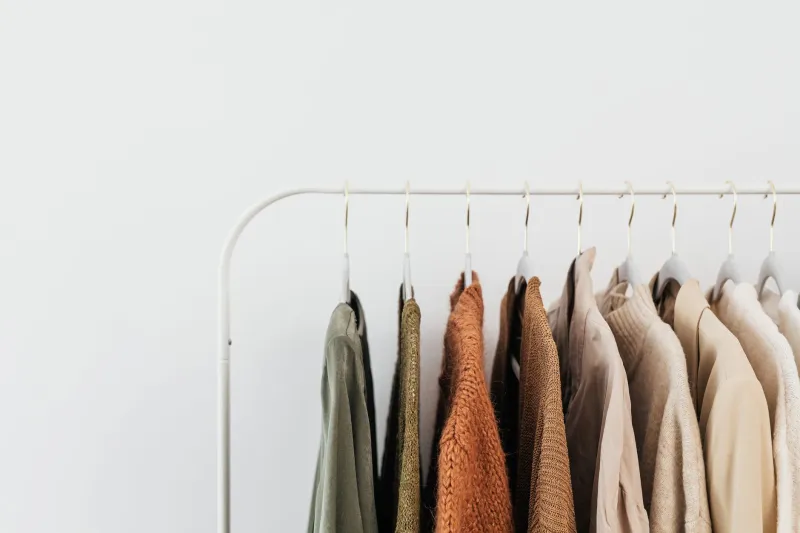
A closet is, in the most literal sense, a record of every purchasing decision its owner has made. Open the door of a wardrobe built without pausing, and you will find the evidence of moods, of marketing, of seasons in which a particular color felt urgent and then did not. Open the door of a wardrobe built with deliberate restraint, and you will find something altogether different: coherence. A visual and tactile consistency that reflects not the shifting pressures of the market, but the stable, considered preferences of a single woman who has come to know herself through the discipline of waiting.
This coherence is not merely aesthetic, though it is certainly that. It is also deeply practical. A wardrobe populated by pieces that were genuinely chosen—rather than reactively acquired—requires less mental energy to navigate. Getting dressed becomes less an exercise in problem-solving and more an expression of something already known.
Making the Pause Permanent
The goal, ultimately, is not to introduce waiting periods as a temporary corrective measure, but to internalize the disposition that makes them natural. This disposition—call it considered restraint, or deliberate selectivity—is less a shopping strategy than a mode of self-knowledge. It asks, repeatedly and without judgment, what you actually value, and whether the object in question genuinely reflects that value.
Over time, this practice tends to produce a particular kind of confidence: not the confidence of the woman who owns everything, but the confidence of the woman who owns exactly what she needs. Her wardrobe does not speak in volume. It speaks in precision. And precision, in matters of style as in most things, is far more eloquent than abundance.
The silence between purchases is not empty. It is where your truest sense of style quietly takes shape.