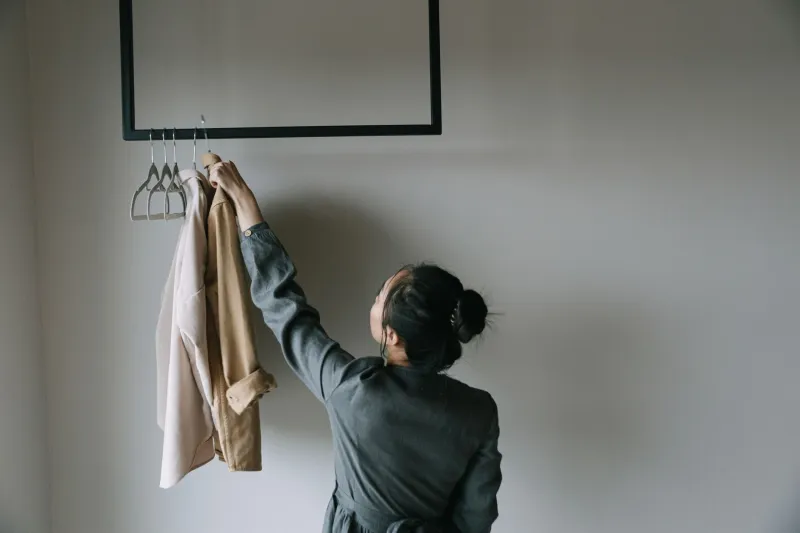
What Stays, What Goes: A Rigorous Guide to Identifying the Clothes That Truly Belong to You

There is a particular kind of exhaustion that comes not from having too little, but from having too much of the wrong things. You stand before a full closet on a Tuesday morning and feel, inexplicably, that you have nothing to wear. The rails are dense. The shelves are stacked. And yet nothing reaches back.
This is not a storage problem. It is a clarity problem.
A genuine wardrobe audit — the kind that produces lasting change rather than a temporarily tidier shelf — requires something most decluttering advice neglects to mention: it demands honesty about who you actually are, not who you once were or quietly hope to become. It asks you to release the costumes you have been carrying for other people and reclaim the clothes that belong, without apology, to your real and present life.
Before You Begin: Set the Right Conditions
The environment in which you conduct this process matters more than most guides acknowledge. Choose a morning when you are unhurried — a Saturday, perhaps, when the day holds no appointments. Clear the floor space. Pull everything out. Not a section at a time, but everything, so that the full volume of what you own becomes visible and undeniable.
Good light is not optional. Examine each piece under natural light where possible. Fabric quality, wear, and true color all read differently in the honest clarity of daylight than they do under the amber warmth of a closet bulb. You are not curating a mood here. You are making decisions.
Have three designated areas ready: one for what stays, one for what leaves, and one — critically — for items that genuinely require more consideration. That third category should be used sparingly. It is not a holding pen for avoidance.
The Questions That Actually Matter
For each piece, resist the impulse to ask whether you like it in the abstract. That question is too easy to answer sentimentally. Instead, ask these:
Does this piece reflect the life I am currently living?
Not the life you lived three years ago. Not the life you imagine having once a promotion arrives or a social calendar fills. The life you inhabit right now, on an ordinary Wednesday. A wardrobe built around a fantasy version of your schedule will fail you every single morning.
When I wear this, do I feel like myself — or like a version of someone else's expectation?
Many women carry pieces that were purchased to satisfy an external standard: the blazer acquired for an office culture that felt foreign, the cocktail dress chosen for someone else's approval, the athleisure set bought because a particular lifestyle aesthetic seemed aspirational at the time. These garments are not neutral. They carry a subtle weight that drains rather than supports.
Is the reason I am keeping this guilt, or genuine appreciation?
A gift from someone you love. An investment purchase that did not deliver. A piece you wore once for a meaningful occasion. These are powerful emotional anchors, but they are not reasons to retain something that no longer fits your aesthetic or your life. Gratitude for a memory does not require keeping the object that holds it.
Would I replace this if it were gone tomorrow?
This is perhaps the most clarifying question in the audit. If the honest answer is no — or even a hesitant probably not — that answer tells you everything.
Recognizing Your Non-Negotiables
Amid the process of releasing, something equally important emerges: a clearer picture of what you genuinely cannot do without. These are your non-negotiables — the pieces that appear in your most effortless outfits, that you reach for instinctively, that feel like extensions of yourself rather than additions to yourself.
Pay attention to patterns here. If you notice that you consistently return to a particular silhouette, a specific palette, or a certain weight of fabric, you are not being limited. You are being told something true about your aesthetic. These signals are worth honoring deliberately rather than overriding with novelty.
Your non-negotiables need not be expensive, though quality matters when a piece is worn with high frequency. They need only be honest — genuinely yours, genuinely useful, genuinely aligned with the person you are on an ordinary day.
The Borrowed Aspirations Problem
One of the most common — and least discussed — forms of wardrobe clutter is what might be called borrowed aspirations: pieces acquired not because they reflect your authentic taste, but because they reflect someone else's. A fashion influencer's color palette. A colleague's polished aesthetic. A cultural moment that felt exciting but was never truly yours.
There is nothing shameful in having purchased these pieces. Aspiration is a natural part of how style evolves. The problem arises when those pieces remain long after the aspiration has been recognized as borrowed — when they occupy both physical and mental space without ever earning a place in your actual rotation.
Releasing them is not a failure of taste. It is, in fact, its maturation.
What to Do With What Leaves
The practical matter of what happens to the pieces you are releasing deserves thoughtful attention. Quality items in good condition can be consigned through platforms such as The RealReal or ThredUp, returned to the market in a way that reflects their original value. Pieces that are gently worn but not consignment-worthy can be donated to local organizations — many women's professional development nonprofits specifically welcome business attire in good condition.
For items that are too worn to donate honestly, textile recycling programs offered through retailers including H&M and Patagonia provide a responsible alternative to the landfill.
The act of releasing thoughtfully — rather than simply bagging and discarding — closes the loop with intention. It honors the original investment, however misguided, and treats the garments as objects of genuine value rather than failed experiments to be hidden.
After the Audit: What Remains
When the process is complete and only what belongs remains, something shifts in the way you interact with your closet. The decision fatigue that characterized mornings before the audit begins to lift. What remains is coherent — not because it matches in the literal sense, but because it reflects a consistent point of view. Your point of view.
This is the quiet reward of the wardrobe audit done with genuine rigor: not a more photogenic closet, but a more honest one. A space that supports rather than challenges you. A collection of clothes that, taken together, tell a true story about who you are.
The pieces that remain are not just clothes. They are, in the most practical sense, your non-negotiables — the ones that earned their place not through cost or sentiment, but through consistent, genuine service to the life you are actually living.
That is the only qualification that matters.